
Why Traditional Talk Therapy Falls Short for Autistic Adults

What if traditional therapy that didn't work for you was never built for your brain to begin with?

You've sat in a therapist's office and been asked, "How do you think your partner feels right now?" And the honest answer that came up was, "I have no idea." Maybe you said something else instead, because that answer felt wrong. Maybe you guessed. Maybe you shut down a little, because a question that was supposed to be simple suddenly felt like you were being quizzed on how to be a normal person.
You've probably also tried different modalities like mindfulness. DBT skills. Naming your feelings out loud in a room with someone taking notes. You have practiced the "I feel X when Y happens" script more times than you can count. You didn't fail at therapy, traditional talk therapy wasn't built for your unique brain.
Most talk therapy assumes you can locate a feeling in your body, name it accurately, and then take a decent guess at what is happening inside someone else. That is called theory of mind, and it is the quiet engine running under almost every therapeutic exercise you have ever been handed. For a lot of autistic people, that engine runs differently, or not at all. How frustrating. This is what I hear a lot of autistic people say that I feel like an alien or they don't belong.
Your brain runs on a different operating system. Once you understand how to work with it, the confusing parts of your relationships, your own emotional swings: it all starts to make sense.
Talk therapy asks you to identify a feeling, name it, and predict what someone else is feeling too. If your brain doesn't experience feelings that way the therapy was never going to work, no matter how many years you gave it or how hard you tried.
The skill most therapy assumes you already have
Most talk therapy runs on a client's ability to report their own internal state and read someone else's. A therapist asks how you feel. You are supposed to know. A therapist asks how your partner might be feeling right now. You are supposed to take a reasonable guess. Neither of those is a small ask for an autistic person.
Interoception is the mechanism that tells you what is happening inside your own body: hungry, tired, anxious, about to cry, need the bathroom. A lot of autistic people have a harder time reading that internal signal clearly or the signal shows up late, after it has already spiraled out of control.
When you struggle to identify feelings, you also struggle to read what's happening between two people, especially inside a romantic relationship. That's the part traditional therapy rarely explains. It just keeps asking the same type of question and waiting for an answer you can't provide.
“I have no idea” is not a cop out
When a therapist asks, "How do you think your partner feels right now," the honest answer is sometimes, "I have no idea." For an autistic person, the answer usually points to something simple. The needed information was never communicated explicitly.
I take that answer seriously instead of pushing past it. If you don't know how someone feels, the goal is not to fake a guess that sounds emotionally fluent. The goal is to figure out what you need to know and how to acquire the information.
A boat is not a broken car
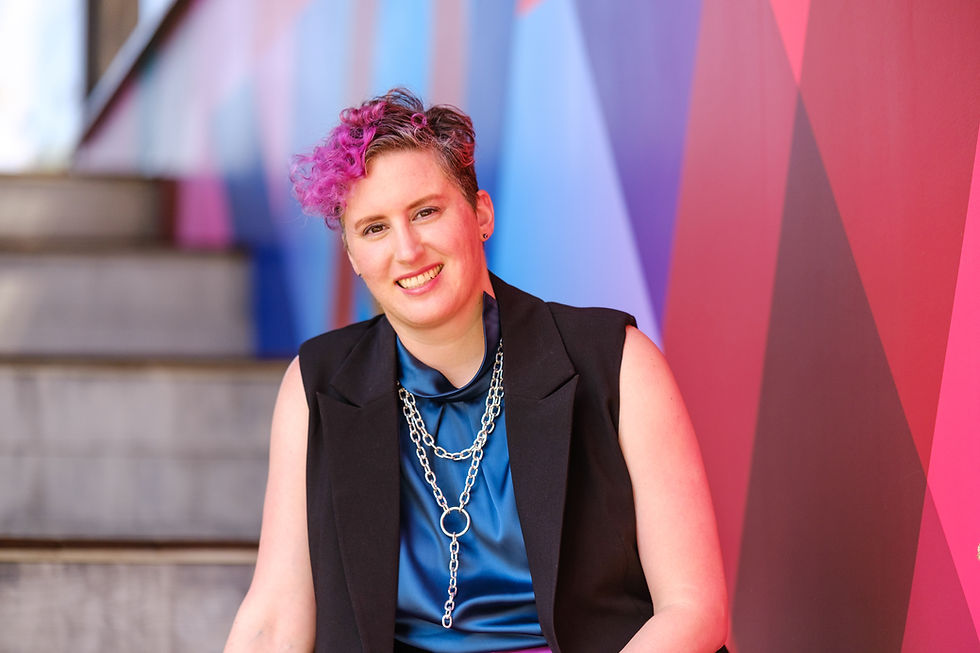
As an autistic therapist, a lot of my work is educating clients on how their unique brains work and how that is different from a neurotypical brain. Different, not worse. You cannot expect your brain to run the way a neurotypical brain runs if you are autistic. Picture a boat and a car. Both get you from point A to point B. They move through a different medium with different rules for how to steer.
Most therapy models are built for a car. If you're the boat, you can drive yourself into the ground trying to operate like something you are not, and still end up nowhere close to shore.
Where the work actually starts: interoception
The first thing I do with an autistic client is build a foundation around interoception which means learning to notice:
Hungry, thirsty, or overdue for the bathroom
Tired or restless/stiff
Hot, cold or in pain
Left unnoticed, any one of those can turn into irritation and irritation can turn into emotional dysregulation.
Knowing the plan: autistic anxiety
Autistic anxiety is not the same animal as neurotypical anxiety, and treating it like the same animal is part of why a lot of therapy fails. Neurotypical anxiety often centers on outcomes: will this go well, will I be safe, will this work out. Autistic anxiety is more often about being perceived: not knowing what to say, not knowing how to act in a social situation.
Reassurance does nothing for an autistic person when the concern is about performance and perception. What does helps is more information in advance, a clearer sense of the social terrain and enough certainty about what's expected.
Understanding relationships through an autistic lens
Once the interoception and anxiety piece has some traction, the second layer of the work is understanding close relationships: friendships, family, romantic partnerships. Do the actions inside those relationships make sense to you, or are they confusing?
A lot of what happens here is building a more nuanced understanding of human behavior than most of us get handed by default.
Timing. Learning when a difficult, emotionally loaded conversation actually has a chance of landing, and when it does not.
Early identification. Catching an emotion while it is still small, before it grows past the point where it is manageable.
Underlying need first. Asking what is actually going on underneath a feeling before trying to change the feeling itself.
Explicit communication. Building the habit of saying the thing out loud instead of expecting it to be inferred, on both sides of the relationship.
This work builds a working map of a terrain nobody explained to you clearly the first time, using your brain exactly as it is.
What this loks like in session
The first session is me getting to know you and your world. Who the major characters are, what the major events and challenges have been, and what you want to be different. From there, we usually meet weekly or biweekly, and I help you identify the tools that actually work toward what you want, not the tools that are supposed to work for a hypothetical neurotypical client. I bring in education and resources as we go, because you deserve to understand why something works, not just be told to do it.
So let's fast forward to actually thriving in life, not just gritting your teeth and getting through each day. Therapy with me might sound different from what you are used to hearing about. Most therapy talks about processing feelings, putting words to your experience, expressing emotion. Therapy with me is more about understanding how your particular brain works, your nervous system's sensitivity, your emotional regulation threshold, and your need for explicit communication. That is not a smaller kind of work. It is the right kind, for a brain like yours.
If any of this sounds familiar
There is no template. Every person I work with works differently, and that is especially true for autistic and AuDHD adults navigating relationships, identity, and everything layered on top of both. If you want support built around how your brain actually works instead of retrofitted from a model that was never designed for you, I would love to talk with you.
Explore more about working with autistic and AuDHD adults, or read more on body awareness and finding the words for the interoception piece specifically.
Book a free consult and let's figure out if this is the right fit.
Maya Attia, LMFT #139693


Comments